De Levende Natuur nummer 2 van 2026 (English summary)
Afbeelding
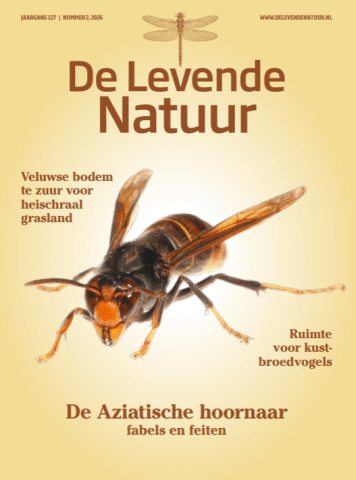
Cover
Suitable habitats for coastal breeding birds
Coastal breeding birds in the Netherlands are under severe pressure as suitable habitats rapidly disappear due to reduced morfological dynamics, vegetation succession, an increase in predators and growing human impact. This article elaborates on the ecological requirements of breeding sites, key management measures, and the importance of collaboration and adaptive strategies. Effective conservation relies on using natural dynamics where possible, active vegetation and predator management, and minimizing disturbance. Regional cooperation, knowledge sharing, social engagement and sustainable funding are crucial for the long-term viability of iconic species such as avocet, ringed plover, common tern, and sandwich tern.
Violion grasslands Veluwe suffer from acidification
Violion grasslands (H6230*) occur on slightly buffered soil and are therefore sensitive to acidification. N2000 area The Veluwe is a very important area for Violion grassland in the Netherlands, but a number of the characteristic species are declining. We investigated soil buffering at nearly 600 locations. Here we also noted the presence of characteristic Violion plant species. For a well-developed Violion grassland, less than 10% of the sites appeared to be home to three or more of characteristic plant species at the same time. These sites had a base saturation mostly between 25 and 75%. Besides former agricultural sites, buffering was provided by the presence of concrete in the subsoil, by the presence of loam, or a location along paths. Conservation of characteristic Violion species at the Veluwe and expansion of the habitat type H6230 therefore require buffer restoration measures and the decrease of excessive deposition of acidifying nitrogen compounds.
The Asian hornet: facts and myths
The yellow legged hornet is a relatively recent invasive alien species in The Netherlands. There are concerns about the impact of this species on public health, biodiversity and beekeeping. In this paper we argue that for biodiversity and public health the effects will be limited: the behavior of the introduced hornet and of the native European hornet is quite similar, as is their poison. Moreover, it predominantly preys on highly abundant and ubiquitous synanthropic arthropods. Honeybees are one of the preferred prey of the yellow legged hornet. When predation poses a threat to colonies, beekeepers are advised to take protective measures specifically in the immediate vicinity of the hives. Actions to eradicate the species are likely to be a waste of effort, as interventions undertaken to date have failed to prevent the high-speed expansion of the yellow legged hornet. Whether public funds should be allocated to support beekeepers is a matter of policy. However, we estimate that the total economic damage in The Netherlands is unlikely to exceed € 500.000. These losses are expected to be negligible when compared with the impacts of pesticides, Varroa mites, and the widespread decline in flowering plant availability.
Rare buffered grassland Veluwe restored
The Leemputten and Verbrande Bos on the Veluwe contain seven Natura 2000 habitat types, including the rare buffered grasslands and buffered fens. Their high ecological value is largely due to shallow, mineral-rich Uitdam clay, which brings base-rich groundwater to the surface, and to historical clay extraction that unintentionally created buffered growing conditions. Long-term monitoring showed a decline of characteristic and threatened species, mainly caused by desiccation, followed acidification (driven by high nitrogen deposition) and excessive grazing. Hydrological measurements revealed that groundwater levels dropped too deeply due to artificial drainage. Based on a landscape ecological system analysis (LESA), restoration measures were implemented in 2024–2025. These included filling in ditches, restoring microrelief, selective forest removal to reduce evapotranspiration, and liming former clay storage areas. Early results are positive, with higher groundwater levels even after dry periods. Continued monitoring is essential to guide long-term recovery and expansion of these valuable wet habitats.