De Levende Natuur nummer 3 van 2026 (English summary)
Afbeelding
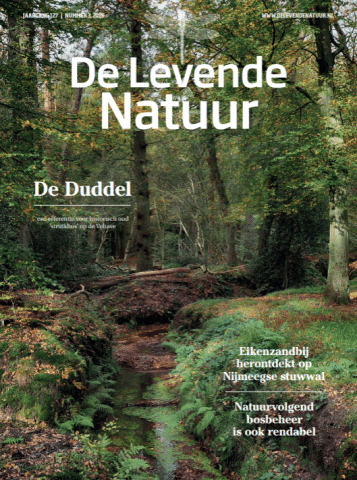
cover
Oak mining bee rediscovered on a moraine near Nijmegen
The oak mining bee is a very rare species Throughout Europe, wherever the species occurs, it is usually observed as a single specimen. In the late 1970s, an exceptionally large population was discovered at the Holthurnsche Hof, a private property on the moraine near Nijmegen. However, this population suddenly disappeared around the turn of the century. Repeated searches afterward yielded no results. A visit to the site in 2016 revealed that the area was becoming overgrown. Nevertheless, a wide variety of bee species was still present, including two critically endangered species: the common long-horned bee and its brood parasite, the large wasp bee. A management plan was drawn up to reopen the site and preserve the unique bee fauna, with the hope of eventually facilitating the re-establishment of the oak mining bee. By 2025, all efforts had borne fruit: the oak mining bee was indeed rediscovered.
De Duddel: a reference for historical old ‘shrubwoodland’ in the Veluwe
Ancient woods are well known in nature management and policy for their high cultural and natural values. The historical extent of these forests is taken from old maps. We use the first Dutch cadastre (land registry) from 1832 to trace ancient woods and consider the applied tax rates as measures of historical productivity. In addition to coppice and high forest, the land registry also recognizes ‘shrubs’ or ‘heathland with shrubs’, usually with higher tax rate than the legal minimum of f 0,25 per ha (Dutch guilders) applied to heathland and sand. This ‘heathland with shrubs’ partly originated from spontaneous establishment of oak and may now have grown into mature forest with many characteristics of ancient woods: historical old ‘shrubwoodland’. De Duddel, a six hectare wood in the Palace Park of Het Loo Royal Estate near Apeldoorn, serves as a reference for this spontaneously developed shrubwoodland on (loamy) sands. The variation in trunk and crown shape of oak, beech, birch and scattered old Scots pine is striking. The soil has never been heavily disturbed, as is the case in historically old coppices and high forests. Ancient woodland indicators occur among vascular plants, mosses and lichens. We summarize characteristics of historical old shrubwoodland and argue not only for continued spontaneous development of this kind of woodland, but also for space for spontaneous development of new shrubwoodland as a natural gradient between heathland and native deciduous forest.
The underwater secrets of the common guillemot
The underwater life of seabirds remains mostly a mystery, including the role of sound. For example, does the common guillemot make sounds underwater? And what does the increasing level of human-generated underwater noise mean for this species? With the help of the Rotterdam Zoo, the authors take the first tentative steps towards finding answers.